What do Illinois tree laws say about cutting trees near a property line?
Illinois’ tree-cutting statute is the Wrongful Tree Cutting Act, 740 ILCS 185. Section 2 covers intentionally cutting a tree you have no legal right to cut, or knowingly having it cut. Either one means paying the owner 3 times its stumpage value. That is the value of the timber as it stands uncut.
An Illinois Department of Natural Resources (IDNR) rule, 17 Ill. Adm. Code 1585, covers how that value is figured. The rule assigns no value to a tree that is not commercial timber. It also does not apply to replacement, aesthetic, shade-tree or landscaping value.
Still, brush and small trees on someone else’s land are not yours to cut. Section 2.8 says the Act does not limit claims under other laws, including common law claims for damages.
This guide to Illinois tree laws is general information, not legal advice. For your own situation, talk with an Illinois attorney or IDNR.
What does the Illinois Wrongful Tree Cutting Act say?
Section 2 reaches anyone found to have “intentionally cut or knowingly caused to be cut any timber or tree.” The tree has to be one they did not have the legal right to cut. That party “shall pay the owner of the timber or tree 3 times its stumpage value.”
The current wording of Section 2 took effect January 1, 2025. That text has no separate rule for an accidental cut, though Section 2.8 keeps other claims open.
Section 2.5 adds a rule for protected land. A wrongful cut there costs “3 times stumpage value plus remediation costs.” Protected land includes nature preserves and property subject to a permanent conservation right. It also includes conservation land trust land and conservation agency land.
All of this turns on whose tree it was. So before you open up a grown-up fence row, find out where your line runs. Our fence line clearing work mulches the brush, vines, saplings and small trees on your side of it.
What is stumpage value under Illinois tree laws?
Section 1(a) defines stumpage value as “the value of timber as it stands uncut.” It is a dollar value per board foot, a measure of wood volume. Only the part of a tree that Illinois forest products markets deem merchantable counts.
IDNR’s rule defines commercial timber as trees of a species and size that a primary forest products market buys. That means wood bought for sawlogs, pulpwood, veneer or cooperage.
At minimum, the tree must produce one stick of wood 8 feet long or longer. That stick must be 4 inches in diameter inside the bark at the small end. No value is assigned to a tree that does not meet the definition.
The rule uses the Doyle Log Rule to figure board-foot volume. The Illinois Timber Price report can be used to set the value. That report comes from the Illinois Department of Agriculture and IDNR.
How is a wrongful tree cutting case valued in Illinois?
Section 3 lets a court order the IDNR Director to “secure 3 independent value appraisals.” Under the IDNR rule, appraisers are timber buyers currently licensed in Illinois. People with at least a bachelor’s degree in forestry who know local commercial timber values can also serve. Under Section 4, the court averages the appraisals and awards triple the average value.
Unless the court orders otherwise, the parties share the expenses equally. The Act lists surveys, consulting services, attorney’s fees and administrative costs, among others. If the person who sued wins, the court lets them recover those expenses.
What does the Wrongful Tree Cutting Act leave out?
Sections 2 and 2.5 leave out “a tree or woody plant referenced in the Illinois Exotic Weeds Act.” That Act names no plants itself. Under its Section 3, IDNR keeps the list of exotic weeds in its rules.
Our Illinois Exotic Weeds Act guide explains that law. Before you count on that exception for any plant, ask an attorney.
Section 7 says the Act “shall not apply to a supplier of electricity, natural gas or telephone service.” That exemption is for cutting trees that impair safe and reliable service.
The Act is about cutting trees. Who owns a tree that stands on the line is a question for other Illinois law. So are overhanging branches and roots.
What does the Wrongful Tree Cutting Act cover in each situation?
Section numbers refer to the Act, 740 ILCS 185. The rule is 17 Ill. Adm. Code 1585.
| Situation | What the law says | Where |
|---|---|---|
| Someone intentionally cuts, or knowingly has someone cut, a tree they had no legal right to cut | They pay the owner 3 times its stumpage value | Act, Sec. 2 |
| The same kind of cut on protected land | 3 times stumpage value plus remediation costs | Act, Sec. 2.5 |
| The case goes to court | The court may order 3 independent appraisals, then awards triple the average | Act, Sec. 3 and 4 |
| Expenses such as surveys and attorney’s fees | Shared equally unless the court orders otherwise. A plaintiff who prevails recovers them | Act, Sec. 3 |
| A tree that is not commercial timber | No value is assigned to it | Rule, 1585.20 |
| Replacement, aesthetic, shade-tree or landscaping value | The rule does not apply to it | Rule, Part 1585 |
| A tree or woody plant referenced in the Illinois Exotic Weeds Act | Left out of Sections 2 and 2.5 | Act, Sec. 2 and 2.5 |
| A power, gas or phone supplier cuts trees that impair safe and reliable service | The Act does not apply | Act, Sec. 7 |
| Other claims, such as common law claims for damages | The Act does not limit them | Act, Sec. 2.8 |
| Who owns a tree on the line, or questions about branches and roots | Other Illinois law covers these questions | Other law |
What should you do if someone cut your trees?
An Illinois Extension forestry specialist gave this advice to a landowner after a wrongful cut:
- Turn down any payment from the logger. The specialist warned it may be construed as payment of damages.
- Contact your local IDNR Conservation Police Officer to file a formal complaint of wrongful tree cutting.
- Work with an IDNR district forester or a professional consulting forester to estimate the volume and value.
Talk with an Illinois attorney before you settle anything. Keep a dated record of what was cut and when.
How do you clear brush near a property line in Illinois?
Find the line before any machine moves. In a tree case, the IDNR rule makes the parties plainly mark the boundary lines before any appraisal. Do that step before any clearing starts.
An Illinois Extension forestry bulletin says a boundary survey is used to establish the property lines of a tract. It calls boundary surveys especially important when harvesting timber, to avoid boundary line disputes and timber trespass.
Start by looking for the survey pins or corner posts. A typical plat of survey shows property lines, corner posts and the location of old fencing.
The same bulletin says a county tax parcel map should not be confused with a legal boundary survey. If the pins are missing or the line is in doubt, call a land surveyor. Land surveyors must be licensed to practice in Illinois.
Ask whether the surveyor can flag or mark the line at set intervals. Then talk to the neighbor before the work starts. Show them the marked line, and keep the work on your side of it.
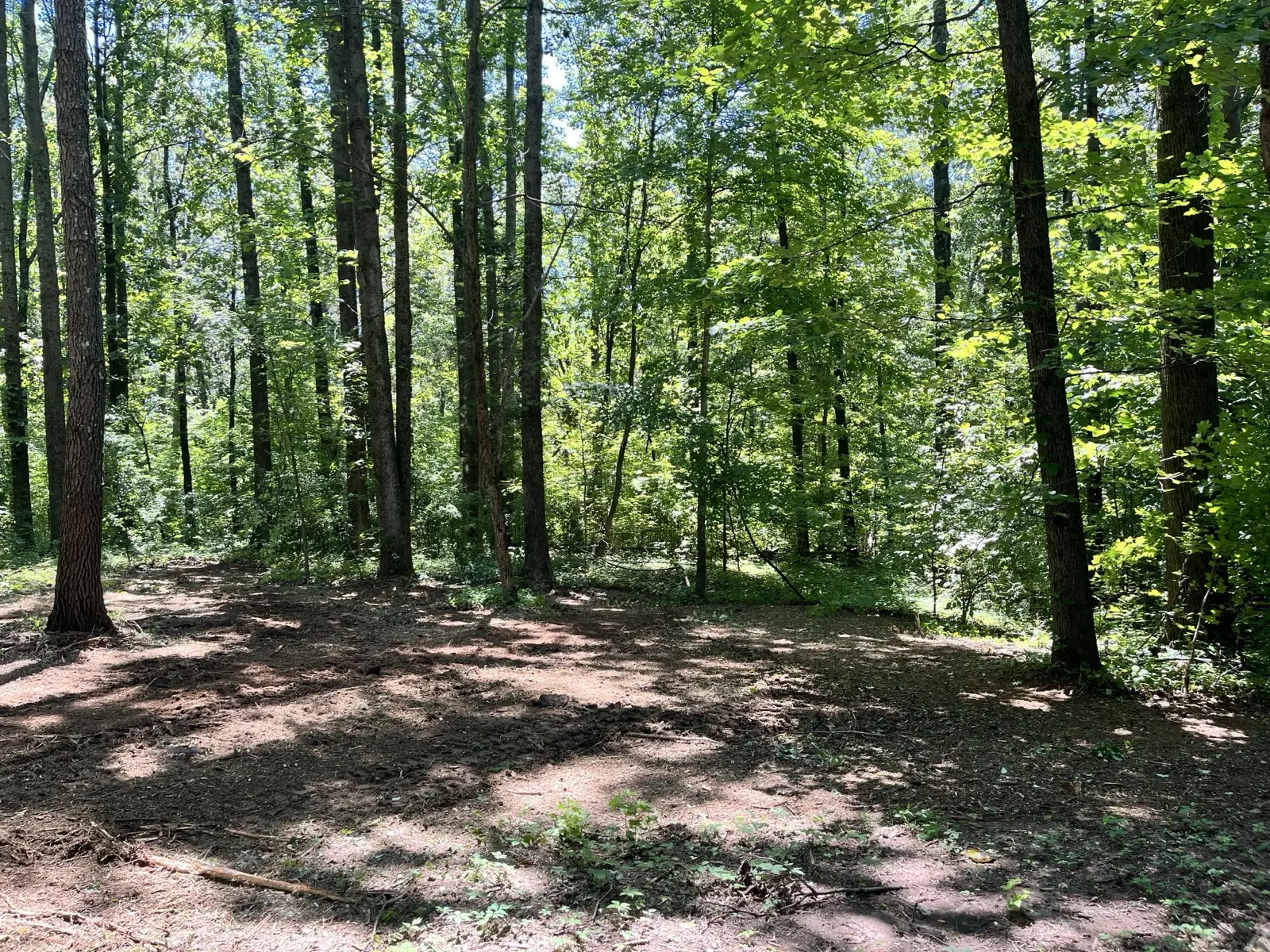
Along a fence row or property line, our work is forestry mulching. A tracked skid steer with a mulching head grinds brush, vines, saplings and small trees where they stand. Stems are cut to grade level, and the chips stay on the ground as mulch.
On land for sale, an overgrown line can keep a buyer from even reaching the boundaries. Clearing a property line so the boundary can be reached and seen is part of our brush clearing work. We are not a tree service. Large trees on or near the line are a job for one.
Other Illinois property line laws can apply too. A division fence on the line falls under the Illinois Fence Act. Our Illinois fence law guide covers who keeps it up.
Need a fence row or property line cleared?
Call or text (618) 697-5190 for a free estimate. Small jobs are welcome. Once your line is marked, tell us what has grown up along it.
Blackburn Land Service is based in Cobden. We work across Jackson, Union and Williamson counties, plus nearby parts of Johnson and Saline counties.